Oil on Canvas
50 cm wide x 76 cm high
PROVENANCE: On hand at artist’s studio. Signed R22 on front bottom right. Artists seal and Certificate of Authenticity in Sleeve on back.
A gray, faceted monument occupies the center of Early Obelisk, Landmark #5. Its tapered body broadens toward the ground, and a narrow dark division runs through the front. Behind it, a blue sky is crossed by pale, irregular bands that gather and change direction around the structure's peaked upper edge.
The largely monochrome monument and ground give unusual prominence to the blue beyond them. Soft shifts of gray model the individual planes, while darker seams preserve the sense of a constructed body. In the foreground, loose, curved marks extend the scene without providing a fixed route toward the upright; their movement offsets the measured geometry of the central form.
The work's title identifies a landmark, yet the surrounding space remains open to interpretation. The obelisk provides a point of orientation within a world whose lines refuse to become a stable horizon. Its compact vertical format concentrates attention on the encounter between an enduring-looking object and a more changeable atmosphere, making the silhouette a starting point for repeated, unhurried looking.
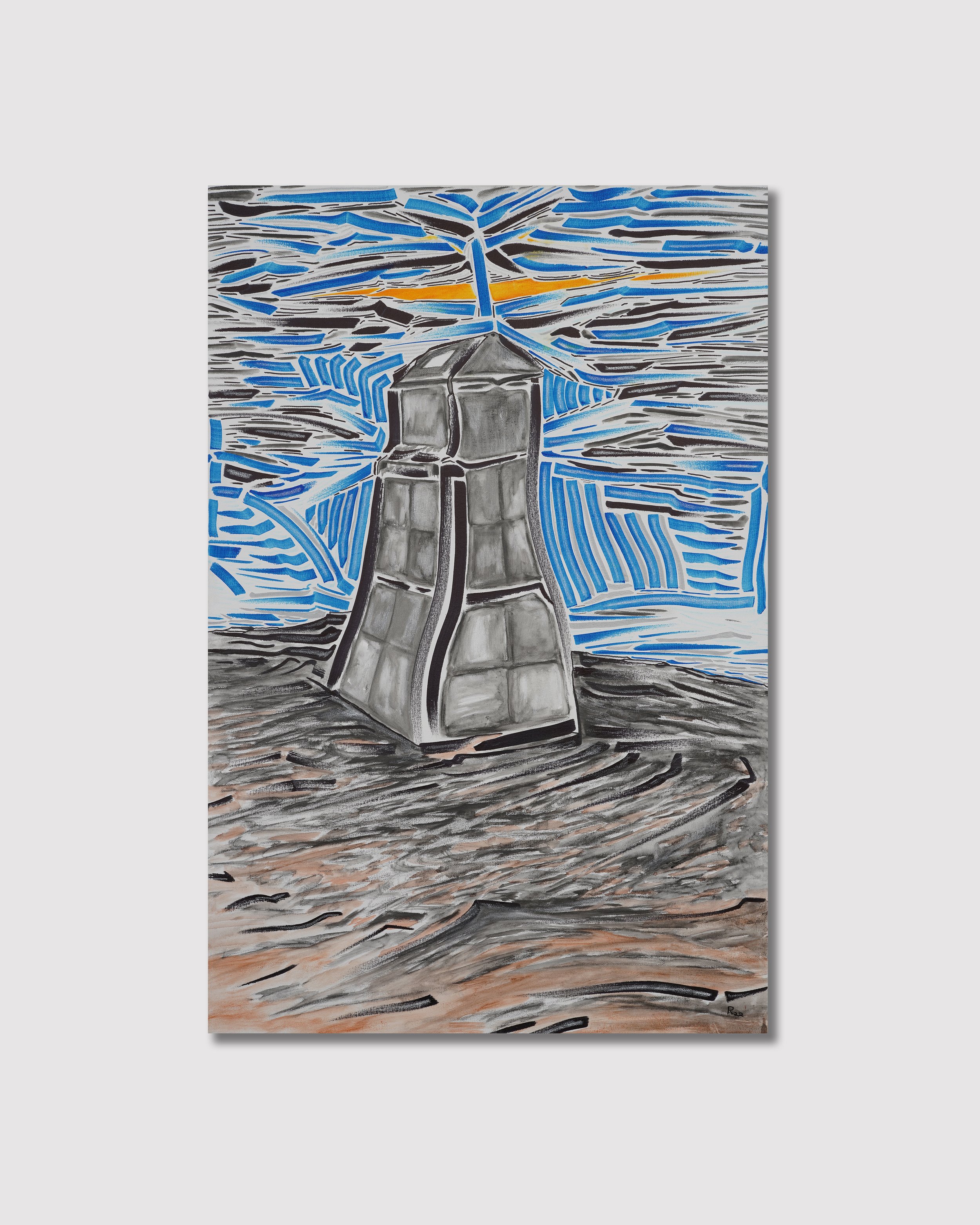 Image 1 of 8
 Image 2 of 8
 Image 3 of 8
 Image 4 of 8
 Image 5 of 8
 Image 6 of 8
 Image 7 of 8
 Image 8 of 8