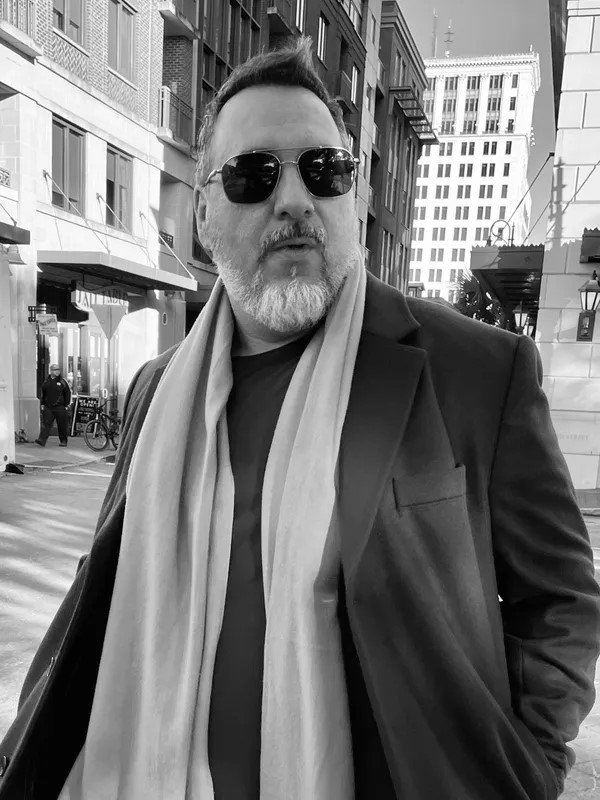
RYAN KARPINSKY
Ryan Karpinsky has spent more than three decades developing a language of painting built around an idea that is deceptively simple: nothing happens in isolation.
A mark alters what comes after it. A mistake creates a new possibility. An object placed on a canvas changes the direction of the composition. What appears accidental becomes structural. What initially seems out of place may ultimately become indispensable.
Karpinsky calls this approach Consequentialism.
Working primarily in oil, his paintings occupy an unsettled territory between abstraction and representation. Architecture appears where architecture should not exist. Figures emerge and recede. Landscapes obey their own peculiar logic. Familiar objects become strangely unfamiliar. Order and disorder continually negotiate with one another.
The paintings rarely surrender themselves immediately.
That is intentional.
Karpinsky has long been interested in the moment when a viewer recognizes that something in a painting does not quite belong—and nevertheless feels that removing it would diminish the work. His objective is not obscurity for its own sake, but tension: beauty complicated by uncertainty, structure interrupted by intuition, and recognizable imagery placed just far enough outside expectation to require another look.
Born in Frankfurt, Germany, Karpinsky spent much of his childhood moving from place to place. The experience of growing up as an American abroad left him with a persistent sense of observing the world partly from the outside. That perspective would become important to his work.
He began painting seriously in 1992.
Early influences included Salvador Dalí, René Magritte, Max Ernst and, particularly, Giorgio de Chirico, whose metaphysical paintings demonstrated that an image could be meticulously constructed while remaining psychologically unresolved. Karpinsky was less interested in adopting their visual vocabulary than in the freedom their work represented—the permission to make an image convincing without making it entirely explainable.
During six years of active military service, he continued to paint, frequently carrying canvases and materials with him. Painting became a counterpoint to military life: a private space in which discipline could coexist with imagination.
Following his honorable discharge, Karpinsky became involved with the Cape Fear Artists’ Co-op in Fayetteville, North Carolina, where painter Tom Waters became an important early mentor. Waters impressed upon him a principle that Karpinsky would retain throughout his career: the artist's first responsibility is to continue working.
And Karpinsky did.
His early paintings were constructed according to comparatively traditional methods. He studied the mechanics of painting, prepared canvases carefully and became fascinated with the craftsmanship underlying older works. Eventually, however, the very discipline he had worked to acquire began to feel restrictive.
He started attaching unstretched canvas directly to studio walls and allowing paintings to develop without predetermined dimensions. Instead of requiring every canvas to begin with a fully resolved idea, he allowed one decision to determine the next.
It was the beginning of the working method that would eventually become central to his practice.
A sprayed shape might establish the architecture of an entire painting. An unintended line might become a horizon. An object lying in the studio might be used as a stencil and permanently alter the composition. Images sometimes develop over months or years as Karpinsky responds repeatedly to what already exists on the surface.
The history of the painting is therefore not concealed.
It remains embedded within it.
That philosophy extends even to his materials.
Over many years, Karpinsky has assembled a substantial collection of vintage oil colors, including paints manufactured decades ago and tubes that once belonged to other painters. He regularly incorporates these older pigments into contemporary works. Their significance is not based simply on rarity. They carry physical history: materials manufactured in another period, sometimes purchased and preserved by artists who are no longer living, placed back into active service rather than left as artifacts.
For Karpinsky, continuity matters.
So does construction.
Recurring throughout his work are towers, walls, openings, distant horizons, improbable structures and deep expanses of blue. Architecture frequently operates less as subject matter than as a means of organizing thought. His paintings can resemble places without describing any particular place—environments that seem to possess histories the viewer has entered somewhere in the middle.
Underlying much of the work is a preoccupation with consequence, time, mortality, faith, memory and the possibility that seemingly insignificant events may ultimately prove decisive.
Yet Karpinsky resists explaining every symbol.
He leaves room for the person standing in front of the painting.
That relationship between painting and viewer remains fundamental to his practice. A work may originate in a deeply personal experience, but once completed, Karpinsky does not believe its meaning belongs exclusively to him. The painting must be capable of continuing without its maker—acquiring associations, interpretations and eventually a history beyond the studio.
Over the years, Karpinsky has maintained an unusually independent career. In Gastonia, North Carolina, he established a large working studio and became involved in the development of the local visual-arts community, including Art Station and the Southeast Center for the Visual Arts.
Throughout that period, he continued building a substantial and varied body of paintings rather than tailoring the work to a prevailing movement or market fashion.
That independence is evident in the work itself.
A Karpinsky painting is difficult to place neatly within a single category. Elements of Surrealism, Expressionism, abstraction and metaphysical painting are present, but none completely defines it. The more consistent signature is the underlying method: one decision producing another until apparently unrelated elements acquire an internal order of their own.
The resulting paintings can be beautiful, peculiar, solemn, playful, spiritual and occasionally disquieting—sometimes within the same canvas.
Karpinsky continues to work with much the same urgency with which he began.
For him, painting has never been an occasional exercise or an accessory to another career. It is a sustained practice accumulated over thousands of hours and more than three decades: one painting informing the next, one period leaving evidence within another, one consequence continually becoming the cause of something yet to come.
As Karpinsky puts it simply:
“I have to paint. I don’t have a choice.”