 Image 1 of 10
 Image 2 of 10
 Image 3 of 10
 Image 4 of 10
 Image 5 of 10
 Image 6 of 10
 Image 7 of 10
 Image 8 of 10
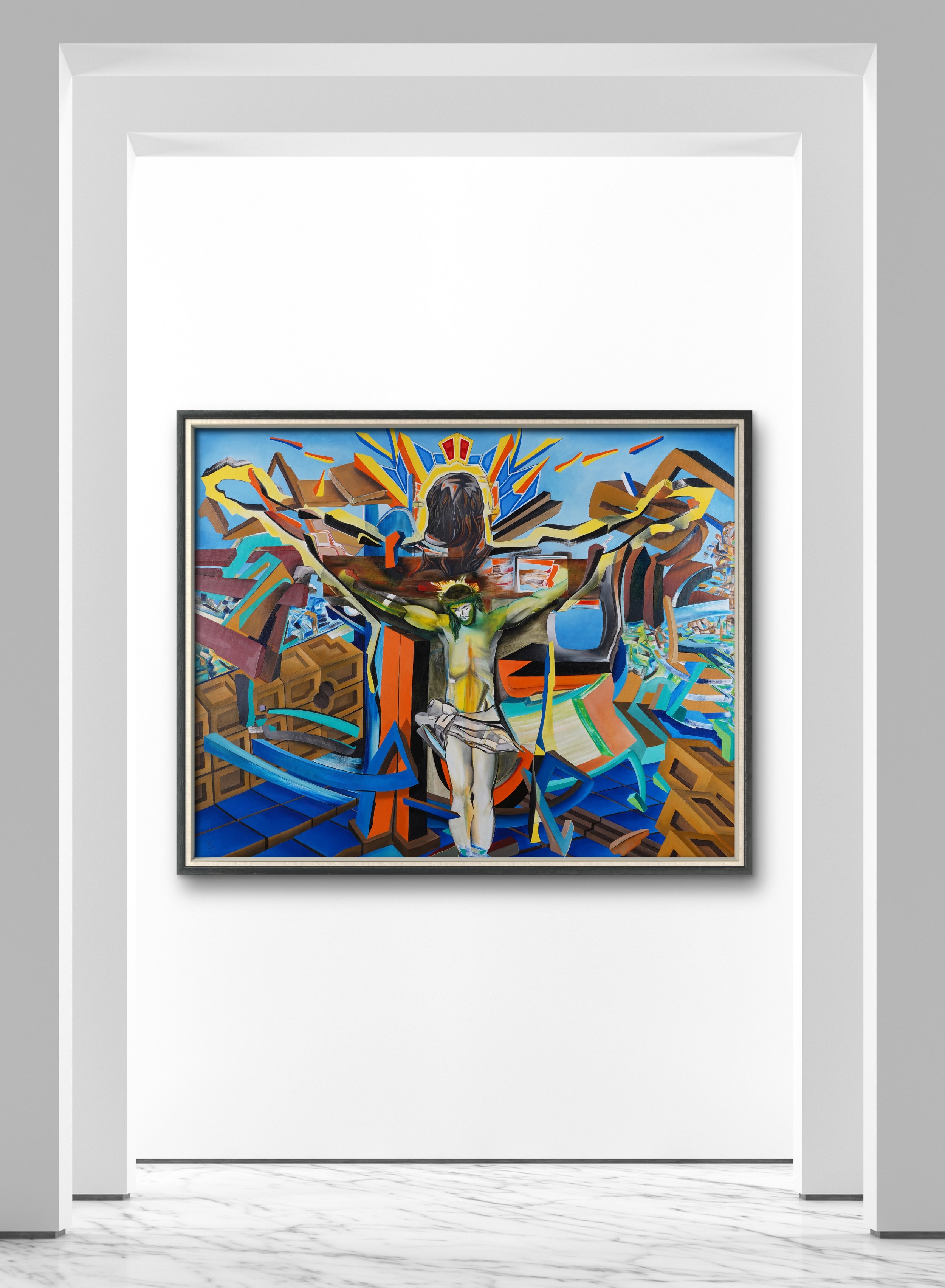 Image 9 of 10
 Image 10 of 10
Semi Abstract Death
This painting began in a way I never could have planned.
In January 2020, shortly before the COVID-19 pandemic, I was awakened around 11:00 at night by an irregular heartbeat. The sensation was bizarre—almost as though small fish were flopping around inside my chest. I had never experienced heart problems before, but my wife insisted that I go immediately to the emergency room.
Within minutes of arriving, I was surrounded by doctors, nurses, electrodes, monitors, wires, IV lines, and the controlled chaos of an emergency cardiac room. My heart had fallen completely out of rhythm, fluctuating unpredictably between roughly 70 and 188 beats per minute.
I was told they needed to interrupt the rhythm and reset my heart. I was given the choice between electrical cardioversion—the paddles—or an injected medication intended to accomplish essentially the same purpose chemically. I chose the injection.
Instead of producing the expected result, my body reacted violently. My heart rate suddenly climbed to more than 300 beats per minute. The sensation literally threw me upright in the hospital bed.
Eventually, another medication brought my heart back under control. I remained in the hospital for several days, and although everything ultimately stabilized, no one was ever able to give me a completely satisfying explanation for why the episode occurred.
But something happened before I left the emergency room that would ultimately become the beginning of this painting.
As the nurses were cleaning up, I asked if I could have the disposable materials left over from my treatment—the backing paper from electrodes and adhesive pads, medical tape, gauze, discarded pieces from the monitors, and other remnants that normally would have gone directly into the trash.
The nurse looked at me strangely and asked why I wanted them.
I told her, “I’m going to use them as stencils for a painting.”
About a month later, I stretched out a large blank canvas and scattered those remnants from the hospital across its surface. I sprayed black paint over and around them, leaving behind an irregular field of shapes—essentially a visual record of that night.
And then I left it alone.
For nearly two months, the canvas simply existed that way.
Then, for reasons I cannot entirely explain, I felt compelled to draw the crucified Christ into the center of it. I searched for several images of the Crucifixion and began sketching. From there, the painting slowly developed around those accidental shapes left behind by the medical materials.
What began as hospital refuse became part of the architecture of the painting.
I continued returning to the work for nearly three years, allowing one form to suggest another and permitting the composition to reveal itself rather than forcing it toward a predetermined conclusion. I finally completed the painting in the early summer of 2023.
When viewed in person, traces of its origin remain visible. Several of the original stencil shapes can still be identified, and areas of black spray paint remain embedded within the finished surface.
For me, this painting is one of the clearest expressions of what my work is ultimately about: taking the seemingly random, frightening, discarded, and meaningless fragments of life and allowing them to become part of something ordered, tangible, and beautiful.
The Crucifixion occupies the center, but the larger presence emerging through the painting is God the Father. His Spirit rises across much of the composition, seen largely from behind, with His arms and hands lifted outward over the scene.
What began with the possibility of death gradually became a painting about something very different.
Victory over death.
The things that were supposed to be thrown away—the gauze, the adhesive papers, the electrodes, the remnants of fear and disorder—became part of the permanent history of the painting itself.
That transformation is not incidental to the work.
It is the work.